NPR producer and Franklyn Cater and former New York chief urban designer Alexandros Washburn visited IU Bloomington last week to discuss Urban Resilience and the NPR Cities Project.
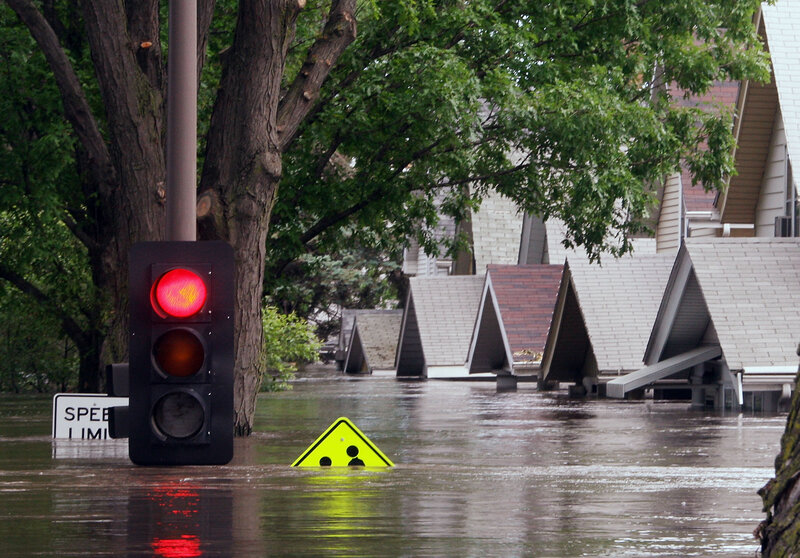
One reason why we need to discussion urban resilience Scott Olson/Getty Images
In order to understand and design a resilient urban community, the hosts of the evening focused on 3 central planning strategies, location, design and mobility.
1. Location: As most of us already know, its all about location, location, location, a fact reiterated by Cater and Washburn throughout the lecture. They illustrated this point by showing communities in Staten Island, NY who lived in houses that were for all practical purposes, located in a swamp. Obviously, this creates problems when significant weather events strike, and after Hurricane Sandy hit the east coast, federal money was granted to buy out some of these homes to provide a buffer from the water. They also mentioned that there are 2 strategies to location, retreat and defend.
Retreat- depending on the building structure or area, one possible way to change 'location' is to retreat vertically, that is, keep building up! If flooding is a foreseeable danger, put all water sensitive items in an upper floor.
Defend: redesign the landscape to provide natural barriers to predicted weather events. Surrounding canals with burms, or redesigning a local flood prone area into a recreational park as in Meadowlands, NJ. The main problems with this strategy are a vast array of political, local, and stakeholder concerns that must be addressed before any project can move forward.
2. Design: Ensure that all new buildings and existing buildings (if possible) are built in a thoughtful way that incorporates resilience and protective measures. Examples of this include, building vertically, insulators, and using tall buildings as natural shading. One specific example of this was utilizing some of these techniques to prepare for a rising heat index in Arizona based on ancient desert city designs/city planning.
3. Mobility: Ensure that transportation is multi- modal, so that if a disaster strikes, people have many options. For instance, when Hurricane Sandy shut down the subway in NY, people could still utilize ferries, bikes, and walking to commute.
This topic is very important in discussing any aspect of sustainability because it pertains to our communities ability to survive and bounce back after natural disasters. Without plans such as these, most other sustainability efforts on the front of food, water, etc are minimized instantly as disasters strike, especially if fresh water sources are not adequately prepared. While trying to minimize additional carbon output into the environment is crucial, we are at a point currently that exceeds the tipping point for what the planet can absorb and we must not only concentrate on solving the root problem, but also preparing for events already in motion because of choices already made by previous generations.
One reason why we need to discussion urban resilience Scott Olson/Getty Images
In order to understand and design a resilient urban community, the hosts of the evening focused on 3 central planning strategies, location, design and mobility.
1. Location: As most of us already know, its all about location, location, location, a fact reiterated by Cater and Washburn throughout the lecture. They illustrated this point by showing communities in Staten Island, NY who lived in houses that were for all practical purposes, located in a swamp. Obviously, this creates problems when significant weather events strike, and after Hurricane Sandy hit the east coast, federal money was granted to buy out some of these homes to provide a buffer from the water. They also mentioned that there are 2 strategies to location, retreat and defend.
Retreat- depending on the building structure or area, one possible way to change 'location' is to retreat vertically, that is, keep building up! If flooding is a foreseeable danger, put all water sensitive items in an upper floor.
Defend: redesign the landscape to provide natural barriers to predicted weather events. Surrounding canals with burms, or redesigning a local flood prone area into a recreational park as in Meadowlands, NJ. The main problems with this strategy are a vast array of political, local, and stakeholder concerns that must be addressed before any project can move forward.
2. Design: Ensure that all new buildings and existing buildings (if possible) are built in a thoughtful way that incorporates resilience and protective measures. Examples of this include, building vertically, insulators, and using tall buildings as natural shading. One specific example of this was utilizing some of these techniques to prepare for a rising heat index in Arizona based on ancient desert city designs/city planning.
3. Mobility: Ensure that transportation is multi- modal, so that if a disaster strikes, people have many options. For instance, when Hurricane Sandy shut down the subway in NY, people could still utilize ferries, bikes, and walking to commute.
This topic is very important in discussing any aspect of sustainability because it pertains to our communities ability to survive and bounce back after natural disasters. Without plans such as these, most other sustainability efforts on the front of food, water, etc are minimized instantly as disasters strike, especially if fresh water sources are not adequately prepared. While trying to minimize additional carbon output into the environment is crucial, we are at a point currently that exceeds the tipping point for what the planet can absorb and we must not only concentrate on solving the root problem, but also preparing for events already in motion because of choices already made by previous generations.

I was a little confused by some of the resilience recommendations during that event. Is it really sufficient to put a wall around the New Jersey coast and build taller buildings? It seems these solutions might address some of the problems that currently exist, but what about future challenges? What happens when energy prices skyrocket and people are living 20+ stories up…will we be able to afford to run the elevators? What happens when NYC flooding is not a once-a-decade occurrence, but instead the streets are perpetually covered in a few inches of water? I don’t know…maybe I’m forseeing problems that are centuries away, but I suspect not! I think I was expecting slightly more innovative projects from these speakers. I did like the frameworks they established though. The part about how you need political support, funding, and design for any project to work was a helpful reminder.
ReplyDelete